The Mission Field
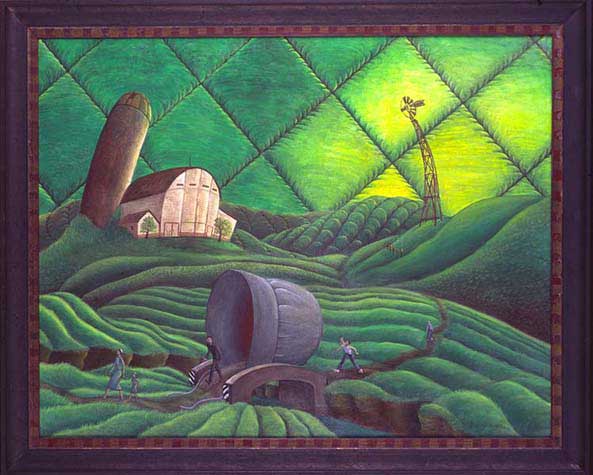
The Mission Field 22x28, 2002, oil on canvas
Available for
Purchase
An outgrowth of the Christian faith is missionary activity, this eastern
religion has sent missionaries to villages near and far as evangelists,
humanitarians, and educators. Postmodern critics suggest that they are
colonialists that eradicate local culture. The Village Voice reported
that one bitter American living in Asia sported a "Missionaries Suck"
bumper sticker on his four-by-four. One missionary's response was: "Culture
is not static. Life is fluid. Culture is fluid. Things are not all good
in an animist society. They live in fear." Culture is like fast-food when
it is part of one's daily diet, but it is exotic when tasted as a foreigner.
Today's missionary teaches theology with great sensitivity to local culture
and customs. It takes great deliberation to separate biblical teaching
from cultural preferences. Most American Christians have set up their
own "safe" subculture and show more interest in political protection than
in biblical discipleship. The Apostle Paul indicated that the spiritual
journey is more relational than political, allowing much freedom in acting
out one's own humanity (i.e., the issue of eating meat from pagan temples).
Mennonites are diligent in sponsoring foreign missions. The advantage
that Mennonite evangelism has in North America is that it does not regard
forfeiting mainstream American culture as a substantial loss. After Calvary,
the second work of grace in this painting is a cultural rebirth. Mennonite
agrarianism cultivates the rolling fields. In a similar color harmony,
the clouds disperse, making way for the very ordered and "quilted" worldview.
Mennonites traditionally held to a plain and simple lifestyle, primarily
by working in agriculture. They believed that living directly from the
earth gives more time for spiritual focus and less chance for sin--less
chance that a farmer will have an affair with a co-worker, use his political
power for corruption, or embezzle funds.
|